
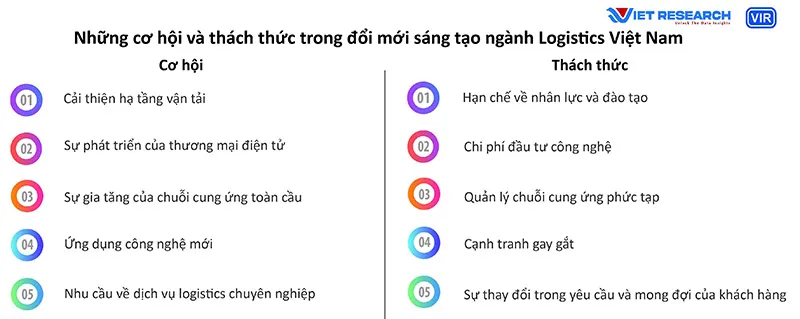
Five opportunities for innovation in Vietnamese logistics
First, better transport infrastructure. The Vietnamese government has committed to heavy investment in transport infrastructure, covering roads, railways and seaports. That creates room to apply advanced technology and innovative processes in managing and operating logistics systems.
Second, the growth of e-commerce. The rapid growth of e-commerce gives logistics firms an opening to innovate in processing, transport and delivery.
Third, the expansion of global supply chains. Logistics firms have an opportunity to raise efficiency and to optimise how goods are moved and distributed internationally.
Fourth, new technology. Technology keeps advancing — artificial intelligence, blockchain, IoT and online platforms. Their development creates room for greater innovation across logistics, from warehouse management to supply-chain tracking and control.
Fifth, demand for professional logistics services. As the economy and trade grow, demand for professional logistics services grows with them. That opens the way for logistics firms to offer innovative solutions, from transport and storage through to supply-chain management.
Alongside these opportunities, the study also identified the top five challenges for innovation in the industry in the period ahead.
First, limits on people and training. Logistics demands staff with specialist knowledge and the skills to meet complex requirements. A shortage of high-quality people and the difficulty of training them is a serious challenge. Firms need to invest in training and in attracting talent with new knowledge and skills if they are to drive innovation.
Second, the cost of investing in technology. To innovate in logistics, firms need to invest in advanced technology such as warehouse management systems, supply-chain management and shipment-tracking solutions. That investment can be a considerable challenge, particularly for small and medium-sized firms.
Third, complex supply-chain management. The industry faces complex supply chains: securing enough supply, cutting waste and optimising transport processes. Managing a supply chain well demands innovation in approach and in process management.
Fourth, intense competition. Vietnamese logistics faces strong competition from firms at home and abroad. To hold and improve their position, firms need to keep innovating and to create distinctive value that attracts customers and partners.
Fifth, changing customer requirements and expectations. Customers increasingly demand flexibility, fast response and an optimal service from their logistics providers. That requires firms to keep innovating and improving their processes, technology and services to meet what customers ask for.
There are further challenges too, such as changes in the legal and regulatory framework for logistics, and difficulties in risk management and information security.
To drive innovation in Vietnamese logistics, a strong and durable innovation ecosystem is needed, supported by policy and regulation on innovation and by investment in research and development. The government needs to foster a favourable business environment, giving firms room to test and apply new solutions. Building a system for training and developing people with innovation skills is equally important if the industry’s competitiveness is to improve.
With that effort, we can hope the Vietnamese logistics industry will keep growing and contribute strongly to the country’s economic and trade development.